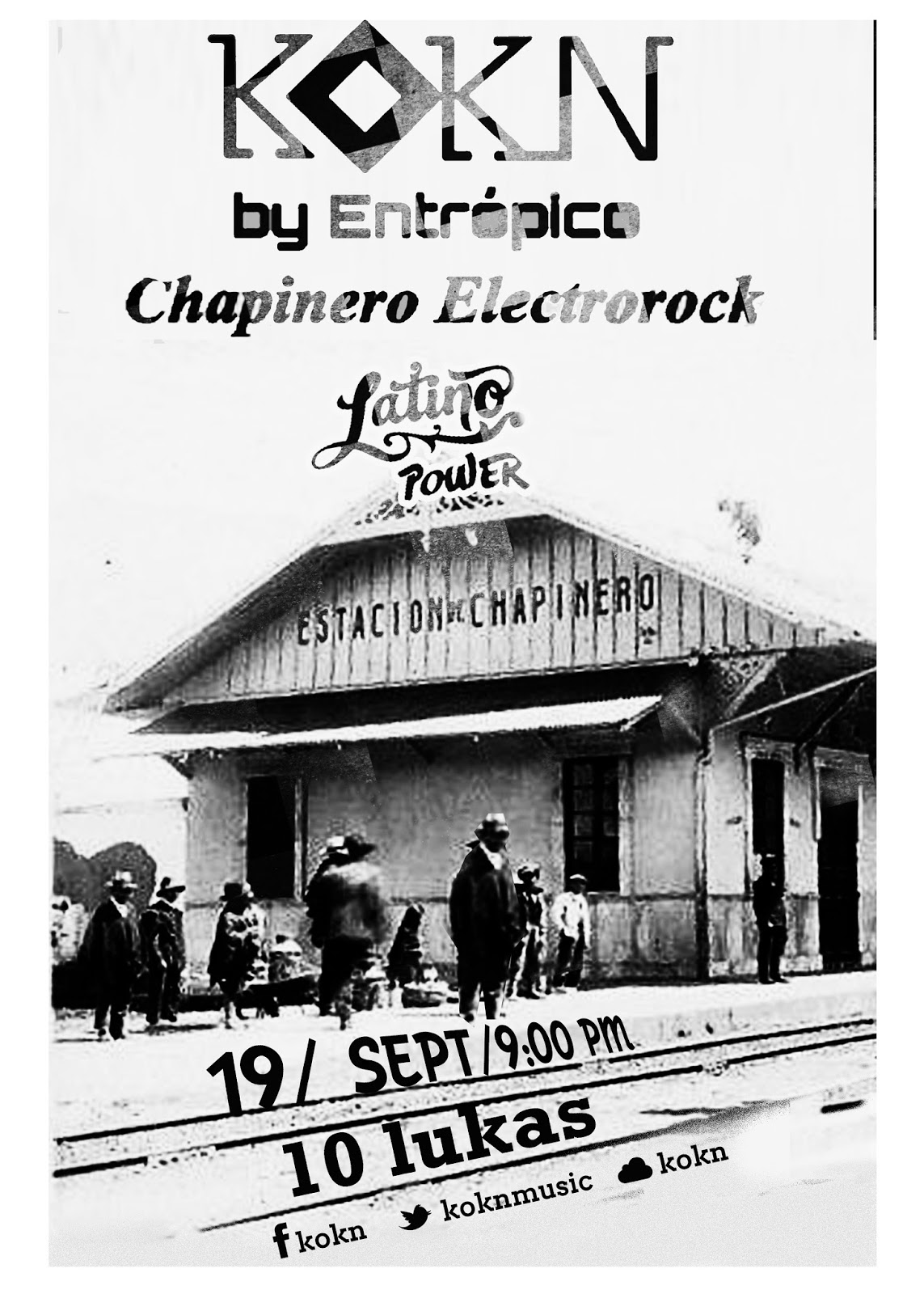
Nuestro nuevo Álbum "Nunca Termina" https://soundcloud.com/kokn/sets/nunca-termina Ésta semana descarguelo gratis antes del lanzamiento oficial en ITunes el 17 de Septiembre de 2013. Escucha y Comparte! También mira nuestro último video http://www.youtube.com/watch?v=HmAuueVp5p0&feature=youtu.beVen a nuestro próximo concierto y lanzamiento el 19 de Septiembre de 2013 en Latino Power https://www.facebook.com/events/122829154554375/con @arteconexion y @pulentamusic. Dale un like a nuestra página en Facebook https://www.facebook.com/pages/KOKN/136739746408928?ref=hl
Our new Album "Nunca Termina" https://soundcloud.com/kokn/sets/nunca-termina This week free download before ITunes release on 17 September 2013. Listen to it and share! Also watch our last video: http://www.youtube.com/watch?v=HmAuueVp5p0&feature=youtu.be Come to our next gig on the 19th September 2013 https://www.facebook.com/events/122829154554375/ with @arteconexion and @pulentamusic. Like us on Facebook https://www.facebook.com/pages/KOKN/136739746408928?ref=hl
http://youtu.be/HmAuueVp5p0
Nuestro nuevo Álbum "Nunca Termina" https://soundcloud.com/kokn/sets/nunca-termina Ésta semana descarguelo gratis antes del lanzamiento oficial en ITunes el 17 de Septiembre de 2013. Escucha y Comparte! También mira nuestro último video http://www.youtube.com/watch?v=HmAuueVp5p0&feature=youtu.beVen a nuestro próximo concierto y lanzamiento el 19 de Septiembre de 2013 en Latino Power https://www.facebook.com/events/122829154554375/con @arteconexion y @pulentamusic. Dale un like a nuestra página en Facebook https://www.facebook.com/pages/KOKN/136739746408928?ref=hl
Our new Album "Nunca Termina" https://soundcloud.com/kokn/sets/nunca-termina This week free download before ITunes release on 17 September 2013. Listen to it and share! Also watch our last video: http://www.youtube.com/watch?v=HmAuueVp5p0&feature=youtu.be Come to our next gig on the 19th September 2013 https://www.facebook.com/events/122829154554375/ with @arteconexion and @pulentamusic. Like us on Facebook https://www.facebook.com/pages/KOKN/136739746408928?ref=hl
Latin American Youth Forum (LAYF) will have a screening session at the British Film Institute (BFI) on 13th March 2011 from 13:00 to 17:00. This screening session will be the second part of our “Together as One” 2011 event which took place at London City Hall last 19th February 2011.
What is Together as One? The event is a gathering initiative, not only to convoke youths but also migrants, from the so-called “hard to reach” communities living in the United Kingdom. The LAYF main objective is to create awareness of young people’s role in this society by providing spaces where young people are able to grow politically and use the arts as a tool to build community, integrate and act as one. “Together as one” took place at Tate Modern in 2009, Rich Mix in 2010 and The London City Hall on 19th February 2011, this year we are also running a second part session at the BFI. The aim of “Together as one” at the BFI this year is to create awareness of issues that affect our communities here in the United Kingdom and back in our home countries; we aim to run a question and answer session after each Short- Film so each group and the audience can have a better understanding of each particular context in which pieces have taken place. Alongside with the work that LAYF has developed with audio visual artist David Caneva, he will be presenting "We are all foreigners" a Video Documentary Game Installation that was launched at the London City Hall.
Which organisations will be taking part?
Native Spirit Film Festival is a non-profit, charitable organisation, which promotes the knowledge and preservation of Indigenous Cultures and supports education in indigenous communities.Native Spirit Foundation was founded and is directed by the Mapuche artist and filmmaker Freddy Treuquil. He is a longstanding and prominent member of the indigenous Mapuche community in Patagonia. Native Spirit holds an annual Festival of Films, talks and performances celebrating indigenous culture, which takes place in London and Spain. During the year Native Spirit also organises events such as fundraisers, musical, art exhibition and film screenings, providing a platform to indigenous artists to showcase their work.
Refuge in Films are a group of young people, some of us are refugees and migrants from all over the world. We meet on a daily basis in Refugee Youth and New Generation, where we run and plan the Refuge in Film Festival since its beginning in 2007. To create the festival, we also make a selection of films that we want to show in the festival, create our own films and produce the event. Refugee in film provides a platform for catapulting our own ideas and views. The festival gives the opportunity for Refugees to re-educate the public in issues they think they know about but really don’t. It gives people the opportunity to look at refugee issues through a different lens.
Colombia Solidarity Campaign is an anti-imperialist organisation, campaigning for a socially just and sustainable peace in Colombia based on respect for the human rights and diversity of the Colombian people. The Campaign actively opposes PLAN COLOMBIA. The Campaign recognises the collusion between the Colombian government, the armed forces and the paramilitary death squads, and calls for an end to the impunity that this creates.
Movimientos runs regular events in London - live Latin music & cultural nights with documentary films, DJs. Currently a monthly showcase night at the Notting Hill Arts Club with the best alternative, cutting edge, traditional Latin and Global live music. As well as regular events at Passing Clouds (Dalston), Chamucos @ Green and Red, Camino (Kings X), Cargo & a 3 month residency at Rich Mix. Movimientos continue to join the dots between all the best up and coming Latin acts in London and some of the most exciting global music around whilst providing a firing club night with all the freshest Latin dance floor heat from cutting edge electronic to Salsa, urban flavours and tropical roots.
Single Homeless Project (SHP) provides innovative accommodation and support services for 3,000 of London’s most vulnerable people. The film-making club is part of a varied programme of activities SHP has designed to promote social inclusion and help people back into work, training and education. The club empowers workshop participants to become film directors themselves. Led by film makers Lesley Pinder and Annetta Laufer, the workshops are supported by a group of dedicated film professionals who volunteer their time to develop the confidence, knowledge and employability of the participants. Alongside a detailed study of film and genre, the workshops support participants to develop skills in camera work, storyboarding, editing, acting, sound, lighting and directing, before culminating in participants making their own film from beginning to end.
Who are we? The Latin American Youth Forum (LAYF) is a project run by Indoamerican Refugee and Migrant Organization (IRMO) a refugee community organization and charity that was established in 1985 and has supported both refugees and migrant from Latin American backgrounds since then. LAYF has been operating since January 2009 and it is a youth lead initiative of over 50 youths that supports their involvement in their communities, promotes a clear vision of their rights and responsibilities as citizens in a multicultural society, helps them address issues concerning their cultural identity and pushes them away from existing negative stereotypical images. To achieve this, LAYF runs a set of educational and artistic activities facilitated by a project coordinator, artists and facilitators.
LUCKY 13 There is no love without tragedy Essay by David Caneva Akle. First part.
“If to regain what was lost I had to first lose what I had If to accomplish a goal I had to endure pain
If in order to be in love it was necessary to have been hurt I have then suffered enough I have then shed my share of tears
Because after all, I have realized that we don't enjoy it as much until after we have suffered first
Because after all, I have understood That what the tree has for blossoms lives from what it has buried”
Soneto - Sonnet Francisco Luis Bernardez
Taking into account different theories and approaches to the filmic, personal experiences and a lively interaction with the subjects while absorbing and assimilating each advice from people that is immersed in the documentary world, it is possible to have a reflection or at least an approach to the aims of this essay regarding the film “Lucky 13”. This is the final film of a trilogy were women and immigrant issues are linked through arts and social experiences of the subjects. The present is also a final support document where the director David Caneva Akle links his two previous visual pieces: “Immigrant of Expression” and “The Warrior” (2009).
The universe of the discourse and a more formal approach will be taken into consideration as backbones of the present essay regarding “Lucky 13”. On the one hand, issues such as the relationship between the author’s perceptions of the filmic and the notion of the feminine setting free from the dominant discourse in which it has been traditionally immersed will be discussed. The latter perspective of the feminine adopted by him and seen through various authors will determine what has been called the universe of the discourse. In this universe, “the feminine” is portrayed as vital to maintain and shape the idea of a film where female subjects, but also directors, are not subordinated to the dominant concept of the woman as a sexual object, diva or as the model of institutional representation . The film is a text, a space of the creation of mutual significations where it is allowed to discover the female subjects and not their phallic but social approach to film narratives, with love, tragedy, sexuality and the vision of society as a whole and not as a defined lecture of the image industry establishment. On the other hand, a formal approach to the concept of the film, its evolution, and its process, is also a part of the main assessments of this discussion. At some points both universes will be intertwined –being the feminine what holds them together- as the author conceives the film as a projection of both aesthetic and critical concerns.
In a simple way, an art object, in this case the documentary in question, is a kind of approach to normal life. It is the interaction with practice, narratives, mass media discourse and dominant approaches that regular sequences of situations in which some narratives and fragments were dropped are evaluated and that a film is discovered within a given process.
In the same order of ideas and analysis, which is part of the academic and scientific process inside the investigations about films, authors and interpretations -a natural subjective vision of the film and the creative process to obtain it-, are mediated by the addition of the concepts of who we are filming and why. The decision to make films where a portraiture nature is dominating over a natural approach to the journalistic style is the difference between an art piece and the massive production of images as an advert. This evolution is revealed within the process of rediscovering a film and a exploited TV show in which the main aim is the economic and the ideological, both part of the cinematographic apparel exploitation of the humans feelings and preoccupations.
On one hand, last century evolution looks like a portrait of different fragments of our humanity preoccupations towards the perception of success and recognition of our modernity. On the other hand, we have the unrepresented, the unsuccessfulness, and our barbarisms and failures as a group of humans.
To join those fragments it is necessary to “interpret what the portrait author (i.e. the creator behind the object) believes and find out how the subject is intended to be reproduced and recognised, whether if it is success and recognition, or failure, tragedy and loneliness.” (Zeldin, 2009)
However, there is a permanent relationship between these preoccupations established by the “civilization of image”, wherein the visual cultural predominance, in the modern western world, turn our individual fragments as collective ones. Those exchangeable relations are born when they are necessary to create a global historical approach to the local stories that art, as a general meaning, produces. Yet, artists are exposed and reflected, rather than related into its subjects when the genuine questions should be what is that thing that is the most valuable? What does our globality represent? and, does the exploration of a non-critic and homogeneous world –the world where we are used to stand- is the right one?
To know or film something about the small culture that surrounds us, whilst living that big space of ideas, is like taking a breath of incoherence in the logical discourse; it is to make from a piece, a public act with repercussions and longevity, something that will last but that is still part of the artist world. In addition, during this discourse interaction and social integration we, subject, object, directors, spectators, learn everything yet discover anything. Each thing is in time and space as an eternal unit where creation takes place, but it is subject to analysis, critic and deconstruction. Firstly, there are our constant approaches as humans, but as artists, we are polarized by different questions that define our own critic –crisis. Why must people listen, read or watch your films, books or music?, is there an imagery recognition to actually represent a spectator or for a spectator to feel identified with? Nevertheless, images are composed by various systems and fragments and there is no reason to think the whole unit of the image can be covered by a specific and unique code. A film has its own shapes, but it also integrates in its discourse exterior signs of different kinds. They belong to other artistic and specific languages, like the narrative, the dramatic construction, the images’ plastic composition, the colour relations inside the frame, the music, different things linked to the light, the expressive effects of photography, the fashion systems, the design and the decoration, the acting moment, the variety of expressions and socialized attitudes where daily communications relay and that relate us with our conversation codes, mimics, gestures, etc. Yet, then we need to add the cinematographic aspect: procedures, camera movements, size and time relations of the scenes, organization of narrative units, montage images and sound relations. At the end, cinematographic language is the composition of the filmic and the filmed.
Both of them, the filmic and the filmed, have to be linked in such a way that allows the main subject to fully develop and stand for him/herself. Some films show us strong characters; they can be like a breath of fresh air in a polluted world or a drink of poison in a magical life in which we succumb within the process of creation.
There is a moment when someone takes the picture and a human, not an object, is revealed. The same sensation of breathing is present when the director discovers that the film is already there before anyone even noticed. As soon as the author portrays images, some things about the humanity of the subject are going to be revealed as a breakthrough, but indeed, everything will also be about the author. Essentially, it is a mutual relationship, a two-way interaction with a degree of reserve, where the author is secondary or a mere spectator.
In Christian Metz’ words, the filmic field explores different dominant discourses, the culture, and genre in a symbiotic activity that produces significances in film languages and messages or transference codes. He is one of the authors from the semiotic movement that find in the linguistic structure an explanation field to different human activities, in terms of significant activities, of course, being film one very significant. Seen from this point of view, the filmic field exploration will bump into fragments, discourses and significances that were broken during the film process. That exploration is a reward, as the author does not have special messages during the process and the final cut of a documentary, since messages come from the subjects, men or women, and hopefully they will contribute and offer themselves up. In this way, the director is a mere observer of the process who by adopting a distance allows the character to emerge and constitute him/herself from all the fragments and significances. During this phase, the director shoots and photographs. If there is beauty, ugliness, obscenity or purity, it will not be seen until much later; he or she will discover what he or she has been unaware of until a given moment. The role of the director in this moment is that of recognising when there is a fragment with potential.
In addition, new codes of interaction with the film world severally affect what the author thinks others feel about a visual piece, but also about human reactions, language, pain and tragedy. All these explorations of the filmic, the film, the subjects and the genre were based and marked as important topics to develop after the study made by the author of the present essay of Gary Tharn’s film, Black Sun (2005) , focusing on the ideas that the others in front of us are humans rather than celebrities. It was also an influence to stop megalomaniac tendencies that naturally nourished the creation process of “Lucky 13”, by letting the author see through the disabled character of Tharn’s film different points of view, and deeply understand how some people with physical limitations and an attached tragedy, survived and still bring happiness to each person and moments surrounding them.
This film Black Sun, with its effects and animations pushed the author of “Lucky 13” to think about the parallel between what we think is reality and what others think about reality. The random use of images of people sharing spaces but without looking their eyes, juxtapositions of voices and images that evoke something led to shape dramatic circumstances were people is not aware of the importance of being alive, breathing and helping others. In the same order of ideas but from the filmmaker’s perception, there is an important value to rescue and to be critical about, which is capturing images and sounds of others, this means the author is part of their intimacy, an intimacy that the camera and the filmmaker is constantly breaking.
However, if there is a permanent disruption of that intimate areas, the subject, the filmic and the filmmaker’s points of view are subordinated to a general shape of our cultural representations, cultural repetitions where we are more often adapted to the idea that you need to believe what you see, conceiving some attitudes as facts that developed in non-objective conditions and perceptions of human beings. Our film culture is now more about consumerism, instead of something, which leads the audience to think about our sense and our projections of what art is. Films apparently have succumbed into arguments, which we just sit to watch as complete tales with happy endings, rather than to interpret values and codes from society on cinema.
Nevertheless, free and voluntarily, documentaries have also adapted to the idea that films are icon-idols and everything apart from the spectacular is boring. Without exciting scenes with guns and romantic clichés, seems as if films are set just to maintain a big market of deaf, blind and mute paranoid spectators, fed by a massive bombing of images of what is good or bad, of what the general code says, or of what the classic narrative proposes.
The model of institutional representation that this essay has been exposing is also represented in the sexual and genre interaction. Traditionally, the questions derived from the critic to classic films and its textual mechanisms of image construction, characterised patterns that reflect women’s position in the interior of a patriarchal unconsciousness. In this same order of ideas, this representation model denotes a merchant character of the film piece with formal characteristics or conventions that the representation produces and repeats, creating significations, like for example, making a woman part of the narrative structure. On the other hand, we can suppose that films, which do not portray women as a sexual object, have different characteristics, discourses and representations that differ from the cultural dominion. Firstly, the reflections about community-individual, the self-questioning, their own identity search against or opposed to what the symbolic order established. Secondly, feminist films and some of the films made by women, and so other movements, like gay, black or Latin, share with the vanguard film or with the countercultural film, experimental or artistic, the seal to crossover the habitual ways of cinematography representation, looking forward to find the diverse, interested in showing subjects closer to the natural or supernatural experiences, in contradiction to the stereotypes that the film and documentary industry produce.
In addition, the feminine -not feminist- reflection that the author intends to link in the film and to support in this essay, is not only to discover some elements from the dominant point of view, but to realise how can a male director talk or intend an approach to films were women struggles are a permanent source of topics and subjects. As a documentary maker is good to understand if the film copes with some pleasures or answers questions to the public about the feminine world even if they are part of the model of institutional representation or if they are following other paths of knowledge and dissertation. A formal approach to what these ways of thinking mean is part of a discovery not related to feminism, but to women in a state of art and work revolution.
“Lucky 13”, the film that follows this essay, is the complete spin of a trilogy were female subjects predominate. Three artists, three struggles, three Latin women in a common place with different migrant backgrounds in the United Kingdom.
These visual pieces are fields of broken colour, sounds and narratives, without any figurative reference points at all. There is nothing in these works for the viewer to respond to except for visual impressions. This is the hue and luminosity of the film itself, the subject and the dominant perception of a woman whether if it is sexual or miserable.
Yet, these feminine perceptions are also part of a general sensation in the films, which is the human struggle, happiness, honour, dignity or abstract words that sometimes arts afford to turn into concrete actions and that not only relate women around the world, but groups of people that have been diminish under the film laws and masculine narratives. Some natural existential fights are part of the act of being and are created from the scratch, were nobody wants to dig, where the industry does not want to look and give founding. At the beginning of this essay there is a poem of Francisco Luis Bernard, the Uruguayan poet whose life was marked by tragedy and struggles, explaining in a deep description what this essay and documentary artwork mean in general for the director and the internal feelings that provoke the following and filming of this third visual piece about the subject who is an immigrant that left her homeland looking for her biological mother residing in London.
Another inspiration materialized in front of the director’s eyes as he was excavating sensuality and women when Nobuyoshi Araki photography’s compilation appeared adding more messy thoughts about genre relations, sensuality and sexuality. Araki is like a forbidden fruit, and for the director, the perfect excuse to understand sexuality, tragedy, the contradiction, the erotic and the feminism.
Araki´s definition of visual pieces is like “Lucky 13” in terms that the film “is waiting for its subjects to give of themselves, offer themselves up to us”. However, this was a point of argumentation with the some other filmmakers and feedbacks because the journalistic style is not contemplated in the film world at all, or at least, it is not well seen, or maybe the director did not know how to do it, but for the author it is necessary to portrait reality as it is, like when she is explaining how she was recovering her life after an almost mortal accident with a bin lorry in the spot were everything happened. In addition, the subject made a big effort when she was asked to walk again over the same steps. As for the filmmaker, to push forward the situation trying to find tragedy. This endeavour, nonetheless, is related to the formal approach –subsequently in this writing- since it is part of the procedure used during the filming.
Johanna, who is a passionate soul with a contagious energy and a definite sense for social commitment appeared during a gig in central London, laughing with a group of friends. The stunning amazing blond woman with a walk stick approached the director of the band and said: “Where are you going so fast?” Instantly, the subject hooked the attention of the room; everybody was in love with her. From this moment on, the filming starts with her evidently realizing that something very sad happened to this woman years ago. First, she recovered from a tragedy with a strong determination which has been tested over burdensome circumstances managing to rise above- like being run over by a bin lorry, or not knowing her mother until her 20's- yet, she personifies a great spirit, inspiring others throughout her poetry. Second, progressively the fragments of her intimacy were slightly revealed. During the discovery journey of Johanna the approach to her life was purely passionate, observational and linked to anachronic ideas, that not everybody could be happy about or at least a little bit comfortable with in life. Moreover, the director was trapped in between the decision to produce a film about her or a film about her accident around central London.
A fearless contradiction of what a strong soul is when she is telling us what the witnesses said when they saw a rag doll smashed by the wheels of a truck. Firstly, the idea of reminding every circumstance that developed in a tragedy as a piece of a big labyrinth where future and past are marked by a permanent present is enough as topic of research and argumentation for a documentary, and sometimes some situations push us to do something in ways that we do not expect. The diary notes during the shooting, clearly showed that tales about cyclists are permanent and painful. Even if the first story was not about an accident, it was linked with the idea of a cyclist. Luis, “The rickshaw”, the subject that was supposed to be filmed five moths ago, is in prison now in a case that requires more research and permissions before going into deep film analysis; it is also the tale of a cyclist in the city. Nevertheless, those days’ different shootings that the director was doing for the previous two short films, and that were never used, were fundamental to produce and film this final one, as the main subject, Johanna, was permanently with the director.
Johanna was there, unaware of the filming process, but at the same time was open and collaborative during the film sessions. Following her histrionic personality for a nine-month period, her family ties, and her immediate past, -related to the group of people that was being filmed, but that she left just before the accident happened-, is a long journey of misinterpretations, collaborations, friendship, discussion and analysis about life and life in films. In that order of circumstances, one important and interesting thing happened when she was introduced to Diana Garcia, the subject from the first film of the director’s earlier “Immigrant of Expression” (2009) . While they were speaking about Diana’s work and Johanna’s life, they realised that both were members of “New generation”, a Latin artist collective based in Vauxhall, precisely the place were the director had been filming for a year. In some way, they were sharing the same codes and expressions as a male spectator filmed them with no interference over the situation. The circumstances became even better, when it was decided to film Laura, subject of the second film “The Warrior” (2009) , but at that stage, Laura disagreed with the person who was supposed to introduce the film crew, as she dislikes ”journalists searching for yellowish stories” the filmmaker was told.
A week after this response from this second subject of interest, Johanna took the director to a small office in which an International Refugee Migrant Organization (IRMO) is based and suddenly inside the office Johanna says hello to a red haired woman as they were not seeing each other for a while. The other woman was Laura.
Then the director realised that both characters, Johanna and Laura but also Diana, were very important and interesting in their communities and indeed as subjects of a Documentary Portrait as well. This evocative situation is the example of what the director believes is a real following of a subject and how three different stories can be linked in a document of life to shape some editorial decisions taken during a film process. In this case the script is based in suppositions of what its seen from the subjects and their way of life, rather than a rigid narrative with beginning and end, starring and co-starring. In addition, this discovery dropped an imminent parallel between the theory and the abstract concept of what an artistic experimental documentary is.
An urgent necessity of the use of colour arose and was now closer to what the director’s perception of feminism could be in a film. The three elements: film, colour and feminism, suddenly clicked at a moment when Laura accepted to be filmed. Subsequently, the tight tie between them was found, as well as the link among the arts and the final film subject, the junction between the exploration of the unknown, and between the technique and the theory.
The reserved definition of feminist film changed tremendously while shooting. In general thinking about a feminist film, there is a contradictory point when it’s believed that it is a society of women; although, it’s been mistaken all along with the terminology. Nonetheless, after these films, it has become evident what it really means. To begin with, it means someone who believes in being treated with equality and vice versa; believing in being humanitarian and trading fairness among all regardless of gender difference. It means feminist film can include men or women, subjects, actors, and directors. Secondly, this film has taught that discriminating women based on their gender role or discriminating Latin or western or black people is not going to solve the gender and social issues, rather, we all have to work together to create a stable and fair society. All these arguments are also based on previous research about the definition of the feminist film, shaped by different thesis of feminist filmmakers that include Gurinder Chadha, Jane Champion, Laura Mulvey, and Sally Potter because their work illustrate the fairness and equality, both in movies and documentaries, and because they portray the stories of reality. Another important element to choose them was their belief in being humanitarian.
This academic researchers and filmmakers related to the “feminist” world are not just part of a capricious exploration of the director to back up the theory about a film for or with women, done by men or by women, they are part of a long research that the author has been doing since he realised that women were part of constant life, a constant psychoanalysis of representations and codes inside the film culture where the women is in fact the narrative, the subject and the final meaning of the dominant culture of image. In this order of ideas, Laura Mulvey -who was also quoted in a previous essay by the author and is a permanent source for investigation-, deconstructs this way of seeing women in her essay "Visual Pleasure and Narrative Cinema" .
Mulvey's article engaged in no empirical research on film audiences, instead, she stated that she intended to make a "political use" of Freud and Lacan, and then used some of their concepts to argue that the cinematic apparatus of classical Hollywood cinema inevitably put the spectator in a masculine subject position, with the figure of the woman on screen as the object of desire. In the era of classical Hollywood cinema, viewers were encouraged to identify with the protagonist of the film, who tended to be a man. Meanwhile, Hollywood female characters of the 1950s and 60s were, according to Mulvey, coded with "to-be-looked-at-ness." Mulvey suggests that there were two distinct modes of the male gaze of this era: "voyeuristic" (i.e. seeing women as 'whores') and "fetishist" (i.e. seeing women as 'Madonna’s').
Mulvey argued that the only way to annihilate the "patriarchal" Hollywood system was to radically challenge and re-shape the filmic strategies of classical Hollywood with alternative feminist methods. She called for a new feminist avant-garde filmmaking that would rupture the magic and pleasure of classical Hollywood filmmaking. She wrote, "It is said that analysing pleasure or beauty annihilates it."
Some feminists criticized "Visual Pleasure and Narrative Cinema," like if she were denying the existence of lesbian women, gay men, heterosexual women, and those outside these identities. For the director of “Lucky 13”, those identities are also reflected in the film, when analysing pleasure or beauty, as well as when analysing pain and tragedy as permanent contradictions. Thus, these contradictions are an awakening to what the film process, the methods and the storytelling are. Moreover, these dissertations about feminism, discontinuity, post modernism, made the process of reflecting the contradictions of arts hard for the filmmaker, in terms of voyeurisms and fetishisms, lacking of modes and codes, and disruption of style. The author tried shaping an approach for that discontinuity of the narratives, as an alternative way to say that he is not interested in the spectator but in the film’s creative result as a an incoherent rant with a passionate voice of the difference.
Directors not always know where they are going and documentaries’ ideas and directions are constantly changing, for this reason, it is not essential to contextualise some situations by providing the audience with information about the past of the subject, this is the reason why she is still thinking and working in present time, and the director followed certain behaviours to show that eternal present. The film is also trying to capture that essence in fragments that build a story from different perspectives, in reverse, upside down, showing a feminine outline of the natural struggles and the many twist of the film’s narrative. The director made the choice not to film her family and past relationships, but her beliefs and thoughts about relationship dynamics, equality, literature and poetry.
Therefore, the constant quotations and discussions about poetry relay on the natural access that the subject has with poetry and recitation. The director realised that the different footages obtained during the filming process at some point needed to be visually organized and put together in such a way that the tragedy and determination of a great spirit could be conveyed with a sensation of a hallucinatory state of mind where the surreal is converted into real.
Normally, the director is not too aware of this process because he is used to shoot everything in an observational style, but during the pre production stage, after trying to break the news method where interviews were conducted whilst people sat down in armchairs, the subject was taken out of the home environment and it seemed to be a lot easier to film in terms of an observational style, however still using the journalistic point of view which was radically condemned and put into questions.
Then a singular approach to the film was revealed as the subject also pushed the daily interaction subtly giving some new clues of her life in a very fragile and honest pose of her intimacy. The fact that the subject is from a generation were women are successful in terms of profession, motherhood and leadership, made it possible to show how domination roles are turning, revealing a new female subject. The director believes that the suitable style was found during this interaction and through the possibility of entering her physical environment and very intimate moments during the night. However, the subsequent discussions and edition method dropped a new version of the film, apparently lacking timeline or story and were the subject was not at all described to the spectators, but indeed, that was one of the breaking points.
During the edition process, all these different faces were showed because of the editing style, but the visual piece was strong enough with the content of the film. After a rough-cut screening, it became obvious that the entire structure of the film needed to be changed. Furthermore, it was necessary to adapt the editing style to the way the film it was shoot. Therefore, it had to be slower and it had to challenge the audience more. Through the filmmakers’ advices, the film was encouraged to leave the audience a bit more in the dark and to have a more mysterious way of telling the story.
Then it was understood that it is important to think of story telling elements. This meant, for example, to make a past story interesting, accessible and relevant now, even if the director thinks is not necessary at all.
Then, during edition and supported by some styles, the definite approach for the documentary was that of a suspense film, leaving the audience to discover what had happened to her and why her determination was actually interesting. But then, that idea of taking the audience on a journey to discover in which context it occurred and why she became a victim, seemed obsolete and so obvious that the romantic, evocative and delicate ingredients of the visual document were lost.
Another element that was also found during the process was the music that the subject and director were listening to during all these months, which in fact derives in a folklore approach to her Caribbean environment and how tragic it is sometimes and, at the same time, so joyful and pleasant for the audience. The uses of “Cumbia” rhythms evoke the necessity of belonging and attachment to personal roots.
Besides music, all the existential fights of the subject and the artist dilemmas are also united by poetry with some sentences that the director found when he first arrived to the place where the subject was reciting and that the filmmaker was expecting to deconstruct to develop a natural approach to the film’s narrative. The aim was to build from the verses a suffered joy of techniques, dialogues and a nonsense repetition of colours and sounds. That is what the director found within the process of this film production in addition to the passion for women and immigrants, films and music.
The Latin American Youth Forum (LAYF) was created as an initiative of young Latin Americans to empower themselves and other young people from migrant communities, to become more actively involved in their communities, to promote a clear vision of their reality as citizens in a multicultural society and become more involved in addressing issues concerning their identity and how to break away from existing negative stereotypical images. Also, to create awareness of the real needs and expectations of Young Refugees and asylum seekers based on their own experiences. Many of the young people that have recently engaged with the project come from European countries as a consequence of the latest migration movements, but they often feel disconnected to European society and unable to address the concerns that they face. The LAYF has developed an ongoing set of educational, artistic and recreational activities that have been delivered to young people from migrant communities, asylum seekers and refugees since January 2009. These activities give young people the opportunity to learn new skills, debate, discuss and play through arts; they also provide young people with critical thinking seminars and free spaces to communicate with people their age in regards to their concerns and ideas.
What is the general aim of the project and its specific objectives?
To empower young Latin-Americans to become more actively involved in their communities, to promote a clear vision of their reality as citizens in a multicultural society and become more involved in addressing issues concerning their identity and how to break away from existing negative stereotypical images. Also to create awareness of the real needs and expectations of Young Refugees and asylum seekers based on their own experiences.
Specific objectives:
To carry out an outreach program that will enable the young people themselves to take part and have a say about how to address their needs and to shape the services and opportunities provided.
To develop an ongoing set of educational, artistic and recreational activities that will bring young asylum seekers and refugees together, giving them opportunities to learn new things and play. These activities will equip them with necessary skills and the confidence to face life in London.
Our objectives are to establish strong communication and support networks between the partner organizations to provide services to young Latin-American refugees. These networks of support will strengthen the organizations themselves and the active participation of the young people in the different projects.
Setup youth steering and Lobby group with representatives of the different groups.
To hold a yearly forum planned and organized by the Latin-American youth (steering group) to showcase their work, and to raise their concerns to the policy makers and the authorities who will also be invited. By the engagement of policy makers it is expected that they will invite the Latin-American youth forum to their consultation process, and take them into account in the decision making process.
"Lucky 13" is the latest film from the Colombian director David Caneva Akle. It tackles one of the most serious and immediate issues for the City Mayor of London: cycling safely on London’s streets. This film explores the human condition from its very simple course of action. It is currently showing on Shooting People (a U.K film network.), where it is an entrant for its "Film of the month” contest. It shows a sincere narrative about love and tragedy, and also how to rediscover life by using poetry as a tool for healing. It is a film about the accidents that happen to ordinary people, a subject matter that isn’t portrayed in any pessimistic way, but with determination and hope that you should want to watch, comment and rate. Here is the link to the movie. http://shootingpeople.org/watch/film.php?film_id=80235
Filmed on location in London boroughs such as Southwark, Lambeth and Westminster (as well as in locations within Central London such as the Brixton and Portobello Market, Pimlico, the London Tube and Westminster University - icons of the diversity of London culture), it takes us through the journey of Johanna, a Colombian woman living in London who, with strength of character, recovered her life as a charismatic, glamorous leader and radio presenter after being struck by a truck four years ago when she had been cycling in Marble Arch. This film is the final piece in a trilogy about women and immigrants, following on from the director’s two previous short films, "Immigrant of Expression", http://www.youtube.com/watch?v=k4wt7IrTJOo&feature=related, and "The Warrior", http://www.youtube.com/watch?v=PmKGFX-cjFY. This third film completes an ellipsis of research about immigrants, arts and women in the U.K. These previous films were screened at the Refugee in Films Festival at the BFI (British Film Institute) during Refugee Week, and at other festivals, small screenings and cinemas around London. They have been well received, earning positive reviews. These films were based on the review of Laura Mulvey’s essay "Visual Pleasure and Narrative Cinema”, in which she explains that an interpretation of “the feminine” is vital in shaping and maintaining the idea of a film in which female subjects are not subordinated to the dominant concept of the woman as a sexual object, diva or as the model of institutional representation.
Sponsored by the International Excelence Santander - Abbey Scholarship, and with the support of the Indoamerican Refugee Migrant Organisation (IRMO), the Director has made special use of his wide ranging musical expertise in the creation of the soundtrack, composing part of it himself, and using original music by the brothers Pablo and Alvaro Gaviria, Colombian based music producers who master the tracks at Mono Studio in the capital city of this controversial country. Lucky 13 explores the concept of happiness with a dizzying Caribbean flavour in its musical mix of cumbia, jazz and folk music.
Reviewed and guided by the inspirational advice of Gideon Koppel, director of “Sleep Furiously”, the practical production approach of Claire Lewis, producer of “The End of the Line”, and “7, 13 and 49 up” for the BBC, and nurtured by the teachings of Victoria Mapplebeck, who made “Meet the Kilshaws”, the film was short-listed for the small screening of “Plug and Play” at the Raindance Film Festival. It is now in consideration for the Glasgow Film Festival, the Birds Eye View Film Festival and the Manchester International Short Film Festival amongst others in the U.K and Europe.
We want to leave you with a beautiful perspective of Colombians living in this country. Not the same useless rhetoric, but a poem to life.
KEEP IT REAL! Hope you will enjoy it. Here is the link: http://shootingpeople.org/watch/film.php?film_id=80235 --------------- David Caneva Akle Audiovisual Artist M.07846161139 Virtual Research Room www.monoestudios.com www.davidcaneva.blogspot.com www.myspace.com/davidcaneva www.youtube.com/naxak
En las noches de abandono, encuentra aquel hombre un asidero a su infortunio. 4 0 5 centímetros de un bebedizo que lo obnubila al punto de ver a su único compañero en la transparente verdad de los debras del alcohol.
Cuando el rosado del ocaso de nuestro tan vehemente fin de semana, se encarna en la silueta de ese hombre, la necesidad de encontrar en ese compañero febril, el bastón aguado, para lo que se presume será una velada de llanto y alcohol desbordado al punto del ávido embriagado de las penurias de una vida prudente pero poco justa con su fiel retina de lo que asimila de la gaia.
En grises pavimentos encuentra colchón, con lujosos vestidos encuentra calor a las frías noches de esta sabana que le da de todo y que insondablemente le quita la vida.
La tertulia no existe en términos de fraternidad compañeristica. Lo único que existe es la preponderancia de argumentos agrios de cómo solventar el trozo de vida que tiene, vericuetos de acciones de lo correctamente permitido y lo entendiblemente soportable para un hombre que vive en espíritu y solo puede ver en su entorno entidades faltas de ese ridículo vocablo del cual lo único que ha obtenido es desgracia protuberante, ausencia de hermandad de sus allegados y un infatigable dedo que lo acusa como la fuente de todo problema que lo rodea.
Vertientes de alcohol es lo que quiere, ríos de etanol es lo que busca. Y solo se ufana por que llegue la tarde rosada que lo acoge como su hijo, que lo envuelve como un padre al que solo le interesa no dejarlo ir en medio de tanta razón, en medio de tanto irrespeto, que viene de la labia de una sala que lo ve encantado en paramos de felicidad, en caminos de colaboración pero que a vergüenza de ellos, solo es un espejo de su falta de civilidad, de su falta de amor por una sociedad que pide a gritos que se le ayude ; y sin quererlo a el también.
De nuevo el estomago se pega a lo que los médicos llaman diafragma, pero en términos callejeros solo es hambre, la cual se suple leyendo, la cual se tapa bebiendo.
Muchos son los que preguntan el porque gastar un centavo en alcohol y no en comida, y es que, para cual es fácil entender que un trago con hambre sabe mejor que beber después de una opulenta cena donde no hay nada que pensar, donde no hay con que mortificarse la vida.
Este lánguido y contrastado hombre solo quiere el espíritu del etil para que su temperamento febril se exacerbe y así olvide la tristeza de una vida empantanada por las ganas de ayudar a quien no lo necesita, enlutada por las ganas de dejar de pensar en la consabida decencia del dinero y sus increíbles bisagras de aceptación.
Hoy sin embargo cuando la resaca ha pasado, el sueño ensoñado de la realidad retórica toca la puerta del oficio, y que con mil dificultades y maleficios, continúa haciendo. Allí donde a veces es, su alma se desdobla y su cueva es el miedo de los demás con los cuales comparte un espacio pero no un tiempo, con los cuales convida una palabra pero no un pensamiento.
Y son estos pensamientos lo que lo hacen impuro, frágil y disidente de la verdad a medias. Verdades miserables que se esconden detrás de bolsillos repletos de conchas llamadas dinero, mentiras creídas en la mitad de un pleito que no le pertenece y con el que se enfermo para nunca aliviarse.
Dantesco escenario lo recorre cada vez que debe pensar, porque algo le dice que sin hambre no es nadie, que sin hambre no crece. Pero el desanimo de entender esta cruel visión es pan de todos los días y por eso no se ha muerto de hambre por que todavía tiene sus ideas antagónicas cazadas en la adversidad de lo que algún día le debió dar oro y solo le trajo precariedad.
Una vez estuve en su cuarto. Me pareció haber visto ese lugar en algo muy parecido a un bar. Un colchón, un escritorio, un mundanal de libros y paginas inconclusas, un baño amarillento por el calentador de paso, una puerta que le sirve de sparing y un lagrimero como el de Nerón cuando mandaba matar su corte, pero que en este caso se llamaba guitarra voz y son.
Esta es la fractura del sonido Artista empedernido Que en las montañas vas creando hermosura Pero en las calles vomitas los acordes de un mundo perdido…
Emocionalmente, va dirigente. Inteligente comenta la gente. La gente palante y atrás solo pretende agradar y el mago se expresa en filas de cemen Que inteligentemente va eyaculando emocionalmente.
Libros de superación en 27 frases de lo que retiene la mente, que sedienta de los demás, se autoayuda en frases de cajón de libros blancos en balcones de consejos, sobre el deber ser, la visión el éxito y las misiones de las vidas autómatas, volátiles ambulantes que ante el asomo de peligro o de confrontada irrealidad, vuelan despavoridas, hacia su guarida, donde nadie las vaya a molestar.
No solo chapas de una puerta por donde sale el vulgar e ignorante se han de reparar para abrir de nuevo la necesidad de seguridad. También las puertas que nadie quiere abrir han de ser reparadas y sometidas ante la falsedad del ser auto ayudado en formas literarias que le cubren la cabeza, de basurillas narcisas, sedientas de misericordia y lisonjeo diario.
Luego las cobranzas vendrán y del amor, solo se rescatará el acompañamiento, por que en el día se hace todo pa dominar a los demás, y felices los técnicos con su cerradura tiene con que mantenerse, gracias a la ofuscada desapariencia de sujetos que a la menor provocación dejan su risa y su proyección feliz y actitudes de la gracia pa convertirse en el mártir agraciado, suculento espectáculo de la porno miseria y sus tutes, falderos de la seducción por apegos antes que por disfrute o pasión.
Las multas se auto imponen, no se consignan en cajas de luz, donde ninguna evolución a de llegar.
Libros de superación en 27 frases, de las cuales la primicia del error es la sosegada mirada de que de facto existe, o que si existen están en los demás, antes que en todos, juntos. Permanecer en un acto de conciencia es y será fatal para el delirante buscador de no caer en ellos, sean estos instantes también llamados éxitos, triunfos, metas conseguidas o vidas normales abaladas con sacrificio, que más da, si los demonios somos todos por dentro, antes que ángeles convencidos de lo bueno que la pasamos en nuestro fascismo mental, burbuja embriagante.
Aprecias el consejo endemoniado de alguien que te abre los ojos… La ironía mac-lujaniana. El despropósito de la lectura popular, La información antes que el conocimiento. The lack of resources, se le puede nombrar como sea, Al final es más fácil el camino fácil, Mientras el otro duerme y se hace el imbecil.
Libros de superación en 27 frases, son el esputo de un cristo agobiado de tiranos, corruptores de la palabra en su espumoso poder. Repartiendo amor hipócrita, tedioso de querer, la soledad rimbombante es lo que mejor pueden ser, escondidos en ventanales , banales lugares, cerrados a la banda y venenosos en el jugoso verbo, audaces hasta para pedir su mas secreto morbo, sagaces para evitarlo y después adjudicarlo a otros, como víboras mortales, de eso se llenan los lugares y de gente que no los quiere ver.
Frases en la superación, 27 son. Las respuestas brillantes de una editorial Dalai Lama, puestas en textos móviles, para responder ante una sencilla afrenta que se convierte en el acto mortífero, para luego contrariamente señalar al que señala, para quedar con la egolatría bien parada, ante amiguitos, ante súbditos, ante hermanos y sobre todo con tiranos, que nada han de remplazar que nada han de entregar, al vivir en el mundo de la disputa a ver quien es más rico o es más puta, a ver lo más por lo menos, a permitirle a la apariencia su cortés persistencia, para luego quedarse a su merced.
Más que asignaciones sobre vidas brillantes, nuestra vida es mas que un camino errante, de nuevo consignado en propalcote barato, con cohanes repisados, con lo que se alimenta las supuestas visiones y misiones y demás mentiras del mundo lacayo, tinterillo y ausente de gracias a cambio de consignas arbitrarias palabras de lo que debe o no debe ser.
Mas bien vale serlo, lanzar palabrones, decir las verdades, buscar predicados, ante que sumirse en la tufillo del mundo aparente y cuando de repente ves a los ángeles mirar de nuevo despavoridos, a volar, todos los fuertes, se derriten ante la mirada reticente, la mente sólida, la vista en la frecuencia de la vida, la pausa ante el acontecimiento perenne, mundano, brutal en la apreciación cual sólida convicción, cuando el ungido lo penetra en los debras del alcohol.
Menores humanos, chicuelos, dados por crecidos monumentos, como odas a la piedra magna, o paradigmas de los pilotes de babilonia. Dopante en su consecuencia, pero ojo abierto con la gloria efímera del que cae en la cuenta que el noosferico, esta ahí, no solo es un Chardin natural de la filosofía gnóstica, en el que se untan todos pero al final pocos han de salir limpios o al menos filtrando algo que valga la pena en tanta nueva era pútrida y gran ola de la dirección succesfull, que castra las huestes del pensamiento puro solar, terrestre.
Que más suerte que tener la vida, que más suerte que ver con la ausencia de los actos impíos del puritanismo y beato slip de información ridícula de la modernidad en la era de piedra. Que más camino para encontrar la suerte de la vida que la divagación y la contemplación antes que el dinamismo y la celeridad de el superastro moderno, con su bonito vestido, pero cero sentido.
El fracaso es la fuerza del destino. No se crea, esta ahí, permanente, presente en cada respirar, por que inhalamos nuestra próxima oxidada muerte y cada vez mas llegamos a la edad mayor y poco sabemos de nuestra humanidad, siempre perdidas en la perpetuidad, en la errada coyuntura de un mundo que no da más, con tanto sapo, chupa sangre, por eso el lago es grande y en él, nos hemos de ahogar.
Dulce esfera de vida, que revela, las ridículas visiones del humano y sus conjeturas de poder, por reconocimiento, brillante deseo de injusto sentimiento de querer planearlo todo, para luego saquearlo y dejar des balanceada hasta su mirada del mundo inmediato en una misión distorsionada, impregnada del deseo farandulero por 15 minutos de reconocimiento etéreo, para un rodearse de falsedades y vivir como el humano cínico y magro ante la bestial desenvoltura del plantea que se acaba, en manipulaciones de hombrecitos menores, que dicen a otros como es que se debe aceptar la vida, como un destinito frondio en un vomito de las negras aguas de las ganancias, para vivir perdidos en fragancias sobre la tenacidad, sabores del aparente conseguir, lo esencialmente estupido.
La influencia se hace con sabiduría, no parafraseando a otros. Se ejerce en el día a día, mirando el sol con altura y no hablando basura, lanzando grafemas en una vida llena de penas, como las miles que hay escondidas en celofanes cocidos con hilos de la esclavitud mental. El otro no nace en cada uno, hasta que no se revela la verdadera esencia del humano desclavado de la cruz, lavado del karma de la sangre de un hombre acanallado por el poder de la roca blasfema de 12 tiranos, reductores del amor hecho verbo a unas cuantas monedillas de sumisión y todo para domar a aquellos pocos que aun pueden pensar y a falta de creerlo se empegotan en recuerdos de lo que debe ser el final máximo, la mirada exacta, la sonrisa perfecta, la belleza social.
Mentiras se redactan en los cuentos sobre la armonía, ni Rimpoche , ni Chopra, ni padres, ni fe.
La satisfacción en si misma, es aun más fascista, sexista, machista, feminista, que cuando vives la paz, de sentirte honrado por permanecer parado, donde nadie quiere ver.
Miles de tormentas, se han batallado, para poder ser, para poder oler, Pero si se pueden miles de espaldas dar, pues claras se pueden recibir, , . manteniendo el pecho frentero e imprudente que jamás podrá sosegarse, al no existir razón para vivir la sobriedad de la razón, ni argumentos para contrariar la serenidad, cuando el mundo apunta equivocadamente. Miles de años más pasarán, miles de escribas habrán de cruzar, y las sórdidas guerras se han de librar, para de nuevo alabar, al que se hace matar por sus convicciones. Valientes sinsabores, ridículas lógicas para prolongar el dolor.
Son tan fuertes estas razones que por eso, se llora y se siente como un inconsecuente que no ve lo que aprovecha el otro creyendo la flaqueza del llanto, que esos mismos lagrimones, los han de llevar colgando en sus corazones, hasta que se pare el juzgamiento, se le abra los ojos al viento y se pueda con coraje aceptar que somos poco hombres para entender lo que es amar.
Libros de superación en 27 frases, esos que todos desean, están puestos en las aceras, están reventando los mercados, para poder rescatar lo poco que queda en esta fuerza inevitable, que se viene y nadie parará. Libros de superación en 27 frases, son el reducto de un mundo amañado al individual interés
27 frases compondrán el libro final del cuasi humano superado, De lustroso aborigen a ciudadano desalmado. Buscando la gloria se ira cortando las horas que le han de quedar.
Esperando miles de fracasos más. Dando gracias por al menos pretender amar. Lo absoluto que lo escriban los demás. En sus libros de superación de 27 frases.
Multimedia Artist with a very dynamic artwork, that began his experience career development, putting into practice his creative and technical skills together. Since he finished university in 2003, he has been working in different fields, mostly related to media studies, such as documentaries, video and television, subjects wich he has been teaching at university.
FILMOGRAPHY
The documentaries Canevakle have produced during this process of finding himself, studying and researching are as follows:
*“Cáñamo Cosmovisión y Castigo” (1998, Final Project Gimnasio Emilio de Brigard school, Bogotá Colombia). This experimental piece explored the use of indigenous medicinal plants by modern urban cultures. It placed emphasis on the use, tastes, flavours and industrial derivatives of cannabis sativa and its different species. It also has a historical compilation of the prosecution of that plant from the 1930’s until the present day.
*Reinsertion: armed conflict actors “Reinserción: Actores del conflicto”(1999. Universidad Jorge Tadeo Lozano. Bogotá, Colombia). It was a Talk show project with participants in the Colombian armed conflict, the civilians and the institutions talking amongst themselves without resorting to argument by using sarcasm and humour. The aim of this project was to understand the atrocities of war and to achieve peace throughout the contradiction in an alternative audiovisual way.
*City Music 2000 (2000, Universidad Jorge Tadeo Lozano, Bogotá Colombia): This video clip is a documentary showing music in different shunned quarters of Bogotá. A visitor explores these areas guided by a local resident and they talk about the area, its problems and possible solutions, meeting bands along the journey. This project was aimed at the relevant regulatory bodies in order to generate development of this area, with the use of audio-visuals.
*Ways of Bogota “Senderos de Bogotá”. (2000. Universidad Jorge Tadeo Lozano, Bogotá Colombia). This film, which was the first of an ecotourism journalism series of 25 chapters, was the result of a long period of research. It concluded that ‘Bogotanos’ were and still are walkers and constantly making new pathways. This process has helped to create the history of neighbourhoods, their urban myths, ghosts and also the connection with the country.
*The Symphony of Noise “La Sinfonía del Ruido”: (2001. Universidad Jorge Tadeo Lozano): Musical Incidental Documentary about the sounds that are in the daily lives of the citizens. These sounds generate a repetitiveness that automates us until we become machines.
*During 2002, I wrote scripts and produced some videos exploring supernatural topics such as the possible landing of a UFO on a hill close to Bogotá in Colombia
I also made a TV series, “El inquilino de la Universidad” (The University’s squatter), exploring the conflicts in the lives of Colombian teenagers.
*During that same year, I participated making educational documentaries for the Psychiatric Faculty of the Colombian National University. They were: (1) Obsessive and compulsive disorder, (2) Gilles de La Tourette Syndrome and (3) Eating Disorders: Anorexia and Bulimia “(1) Trastorno Obsesivo Compulsivo, (2) Trastornos de Guilles de Latourette and (3) Trastornos del comportamiento alimenticio: Anorexia y Bulimia:”. All of them were part of an educational research Project, where psychiatry students could observe the characteristic symptoms of people with those problems or deficiencies caused by the lack or increment of chemicals in the human brain. In addition, the documentaries induce medical solutions and explanations for relatives and patients. These works were made during my internship in Tucan cinematographic productions.
In 2003 with a group of classmates the following documentaries were made:
*Public Health “Salud Publica”: This work reviews the concept of public health as a set of cultural practices, where not only the lack of illness counts but also the well being of society. It criticized the way mass media predated this right and it invites them to participate actively in the diffusion of responsible concepts about health.
*Coca leaves “Hoja de Coca”: On a different note, this short video clip documentary draws a parallel between the plant of Coca as an ancestral medicine and its degradation by the modern world, which converted it into cocaine. Starting from this basic differentiation, the plant was redeemed as a traditional and transcendental indigenous ritual separating it from the trafficking conflict and its demand that arises from the lifestyles and economic support from the western modern world.
*Another documentary was called Interrupted Vivid Green “Verde Vivo Interrumpido”, which was a visual experiment, showing the lack of management when treating waste in conservation areas of Colombia, especially in Suesca hills. It then goes on to show how this waste is inevitably integrated into the landscape under the indolent view of the irresponsible ecotourism.
*In the year 2005, when I moved to the city of Catargena, I observed that the opulence of the occupants within the walls of the city contrasted sharply with the misery of those outside, with the privileged not wanting to acknowledge the existence of the poor. As a member of faculty for film and television in the department of Social Communication of the Jorge Tadeo Lozano University in Cartagena I started to develop audiovisual pieces focused on this contrast. A group of my students and I developed the following documentaries:
the theme central to this work was the traditional feasts commemorating the independence of Cartagena, which seem to get sidelined due to the celebration of the National Beauty Contest. There is a queen associated with the traditional feast as well, whose beauty represents the emancipation of the people of Cartagena, while making a satire of battle for independence, critiquing the origin and future of this tropical city. This documentary was relayed by a national channel for a month and its copyrights were sold to a local channel, and currently it is shown as one of its cultural programmes. On the Independence Day commemorations in 2005, this documentary was used to open the feast to hundreds of spectators and an honorary mention was given by the city Major to the University acknowledging the importance of this work. It was also shown in the International Film Festival of Cartagena, where it was well received by the critics, making it the first time that the Tadeo University participated in this important event.
Following this success, the university issued grants to me in a very short period of time to make more films. These were about the people of Cartagena that work for the city, the foreigners that contribute to the Cartagenan culture, history about the traditional neighbourhoods of “the Heroica” and other topics pertaining to the youth. These films are part of a series that is shown as part of the sunday line-up on the Cartagenian television channel, Cartagena Total and the episodes are titled: The Siders
Youngs with Youngs “Jóvenes con Jóvenes”, My Neighborhood Counts “Mi barrio Cuenta” and Opening Doors “Abriendo Puertas”. These series are still being aired and they provide an opportunity to to use documentaries as an alternative tool to communicate social issues to the masses. Amongst these series, a documentary about the marsh La Virgen was the result of a wide research that I have been working for about four years.
With the arrival of 2006, the audiovisual department of the university became more active and organized, attempting to improve the image and the sound quality of the production. This led the university to ask me to lead a group of 14 people to make another documentary about the independent feasts of November. It was completed very recently and the result was an high quality work called Faces of the Feasts:Journey around the music and the Cartagenian folklore
The documentary navigates around the musical ideals of this city on the Caribbean coast of Colombia. It tells the stories of the most significant composers in the musical history of Colombia. There was an attempt to capture and express the spirit of their music and the aspects that motivated them, which have enabled their music to last over the years and become iconic of the culture of Cartagena.
After this I filmed and finished a documentary about the women who had to assume the status of head of the refugee families because of the loss of men due to the armed conflict in Colombia. Although this job is sponsored by an NGO belonging to the European Union, I feel closely involved to the project as it deals with the region of the marsh La Virgen, which has been central to a lot of my research since I was an undergraduate student. With this film I hope to expose the crude reality of the manner in which the Colombian government has abandoned these communities, while attempting to help integrate them with the society that denies their existence. WATCH THIS LAST MOVIE
Desarrollando una autodidacta formación musical desde la infancia como cantante y compositor, en un principio me involucre con el mundo teatral para niños y jóvenes, así como de interpretación de música folklórica del caribe colombiano durante mis años de estudiante de primaria en Bogotá. Gracias a las oportunidades escolares y a través de la formación musical me hice merecedor de premios y reconocimientos tales como el Primer Puesto Solista Masculino en el “Festival Juvenil de a Canción Luna de Plata” del colegio Abraham Lincoln en alianza con otros colegios del norte de Bogotá. Un tiempo después, en el “Modelo School”, realizado por la Unión de Colegios Internacionales” en los años 80´s obtuve un destacado reconocimiento como joven interprete frente a un publico adulto quien me otorgó un incentivo económico para seguir adelante en estudios musicales patrocinados por Milo y la UNCOLI. Durante los años 90´s decido ahondar más en los contenidos de las letras y la promoción de eventos mientras cantaba en clubes, pequeños concursos, presentaciones privadas, realizando un repertorio de música social, e inclinándome por el estudio de la música cubana de los años 60´s y 70´s, así como de el punk , el rock y los principios del sonido electrónico en Latinoamérica, que ya se mezclaban con los intereses musicales que me tocaban como joven adolescente en medio de en país en crisis permanente. En los años 1993 a 1995, me sumergí aun más en el manejo del negocio de la música. Paradójicamente vendía entre amigos cassettes grabados de “La Tuna Van Camps” una sencilla unión de pequeños músicos de colegio que parodiaba canciones tradicionales del mundo. Mi gusto musical se involucró con la música vallenata, creando un grupo juvenil que se hizo famoso en el sector de Teusaquillo, por su movimiento dentro de los sitios de rumba y universidades de este tradicional sector donde no era común ver gente joven bogotana interpretando música tropical colombiana. Decido, antes de finalizar mi bachillerato en 1996, formar una banda de punk metal, en donde reencuentro el camino de la autogestión y de la producción de música independiente. Es así como en 1996 nace
famoso entre la corriente punk rock post grunge de Bogota por su tajante critica social,. Con esta banda el proceso de producción y promoción hasta el año 2000 , se convirtió en un reto y una multiplicación de una posición e ideología fuerte de música y política Por tal razón fuimos invitados a las controversiales “Tomas de Miedo” paralelas a la organización de “Rock al Parque”, organizadas por la Alcaldía de Bogota en los lugares vedados de Bogotá, a los distintos festivales de bandas de Kennedy, Bósa, Fontibón, Niza, (localidades de Bogotá), así como múltiples presentaciones en instituciones universitarias y privadas. En la Universidad Central desarrolle junto con la banda en 2001 un feria de autogestión, usando la radio y la publicación masiva de un Pazkin, sobre el movimiento musical subterráneo del centro de Bogotá durante un encuentro cultural estudiantil junto con estudiantes de Las Facultades de Derecho y Ciencias Sociales de la Universidad Nacional. Creamos nuestra propia red de ayuda, para producir música, video y comercializar artistas de una manera alterna al modo establecido, sacando adelante “GRID Taller creativo”, en alianza con SINERGIA Ltda., desarrollamos la musicalización para distintos cortos y multimedia, como el primer CD interactivo de María Paz Jaramillo. Como joven emprendedor en el negocio musical y otras artes, y aun sin ser músico activo, comencé a formar criterio de organización social por medio de encuentros ciudadanos de deportistas, músicos, artistas plásticos durante el año 2000 en el semiciclo del Parque Central Bavaria en una cooperación junto con la Red de Skaters de Bogotá e INCA Sports, ayudado por emisoras locales de la época y Bavaria. Esta Red sirvió para ayudar a otros artistas con pocos recursos de producción y realización que dio lugar al desarrollo de proyectos para músicos en “RECstudio”, oficina musical de masterización y editorial de Bogotá, durante los años 1999 y 2002, enlazando artistas y enseñándoles a promocionarse desde lo básico como creativos independientes. Este emprendimiento dentro de la industria musical demostró la habilidad para generar e impulsar procesos de creación que pueden generar cambios en las conductas y entendimientos sociales. Al desintegrase “Farsa Sésamo” continué produciendo y promocionando música , a la vez que estudiaba mi carrera de Comunicación Social en la Jorge Tadeo Lozano de Bogotá, con lo cual logre involucrar con mis estudios de semiótica y lingüística el proyecto sonoro “AN4913”, una compilación Hard Core Electrónica mezclada con sonidos urbanos que desarrolle con el guitarrista de la banda de Hard Core bogotano “D2”. Esta unión musical alcanzó un momento clave en el 2001 durante el “Festival de Rock al Parque” mientras trabajaba paralelamente como periodista en el semanario “El Espectador”, empresa por medio del cual realice una especialización en periodismo investigativo y cultural en “ANDIARIOS”. Gracias a esto inicie un trabajo con la revista “SHOCK”, en donde utilice mi conocimiento musical para introducirme en una visión no tan periodista de la música. En este momento mi interés por impulsar mi propia música, así como la de otros artistas amigos, me enfocó aun más en la idea, de que la salida al conflicto armado colombiano, es el desarrollo del arte permanente. Por tal razón la búsqueda de recursos y alianzas se volvió una constante, en donde la colaboración entre redes urbanas se mantuvo para así desarrollar proyectos como las fiestas de “UltraBass”, las fiestas electro visuales en las minas de sal de Nemocón y Zipaquira, entre otros ejemplos, demostrando como, de una forma alternativa, se integran las culturas, en la sostenibilidad y novedad en el manejo de espectáculo de la música y como se puede fomentar esta visión de paridad social utilizando las herramientas de integración y las tecnologías. www.davidcaneva.blogspot.com En el año 2005 una unión de bares de la Carrera 7ª de Bogotá y la productora musical AMEBA Records galardonó con el primer puesto a “Doppler”, banda en donde participaba en unión con músicos de la Universidad del Bosque durante el Festival Rock Bajo la Séptima. Este hecho produjo la realización del sencillo “Doppler I” con el cual logramos desarrollar un rock muy especial, muy radial, que me llevo a otro nivel de percepción del mundo musical colombiano. Este sitio virtual tiene sonido que identifica a “Doppler”.
Durante estos procesos he desarrollado mi carrera profesional como compositor e intérprete, he producido múltiples campañas publicitarias para radio y TV, he performado, colaborado y desarrollando mercadeo, y autogestión comercial con artistas como Los Zancudos, Entrópico, Dj Felipe, Gozona Record System, Paralelo 6/40, Dj Springfield and Arias, Estilo Bajo, Madera Fina, ChiflandoIguana, así como también financiando investigación y apoyando desde la academia a las distintas manifestaciones artísticas visuales sonoras que existen en Colombia. Y es precisamente en este campo académico donde encuentro refugio para impulsar y multiplicar desde la creación artística con nuevos medios, los conceptos y teorías de comunicación popular comunitaria y el edu-entretenimiento como fundamento para el desarrollo del arte y la cultura como herramienta de paz. Este camino de conocimiento aplicado a la música me llevo a Cartagena durante 3 años como catedrático, mientras formé dos proyectos electrónicos. “CANEFITO” con quien realice cover´s electro de la música en español de los años 80 y el proyecto individual más reciente con el que me encuentro ahora
con el cual conforme un grupo interactivo de video y audio con el que me presentaba en fiestas y clubes de esta ciudad colombiana. Este interés y búsqueda de “la música como herramienta de paz” fue una propuesta de tesis que autogestione durante una especialización en Comunicación para el Desarrollo en el año 2006 y en la que realice campañas de promoción en radio, televisión y espacios virtuales teniendo siempre en cuenta las caras comerciales y de distribución, Fue así como llegue al producir dos documentales con la Jorge Tadeo Lozano, Tele caribe y el Canal Cartagena, sobre folclor e identidad del pueblo cartagenero, investigando a sus músicos y compositores así como a sus folkloristas más tradicionales y su prolongación de las tradiciones en las raíces sociales, en los niños, en las familias, en los barrios, en sus formas de expresión y sus esperanzas como pueblo musical.
En este lapso de estudio, producción y promoción artística decidí mejorar mis conocimientos, embarcándome en un viaje a el Reino Unido y Europa en 2007, tras un M.A relacionado con estas temáticas sociales que vagaban en mi mente. Llegue a Londres donde encontré un abanico de posibilidades de desarrollo del negocio cultural, y en Royal Holloway University of London busque un cupo en una Maestría de Investigación y Producción Documental el cual obtuve, después de haberme preparado por seis meses para mejorar mi calificación del IELTS. Paralelamente me desarrolle como artista y promotor de música latinoamericana, relacionando mis presentaciones con el mundo nocturno de Londres en donde encontré asidero y promoción de primera mano, fácil de digerir y muy puntual sobre los artistas y la radio en el Reino Unido. Me contacte con festivales, bares y clubes en donde realice performances electroacústicos con músicos y organizaciones que encontré en el camino. Cree otros círculos de trabajo, impulsado por una red de artistas llamada “MOVIMIENTOS” y la “Latin American Solidarity Campaing”, ambas organizaciones inglesas, desarrollando una propuesta de promoción artística en sitios como The Notting Hill Arts Club, The Pelikan en el Porto Bello Market. en el sector de Angel en “The Salmon and Compass”, en el “EGG” uno de los clubes mejor rankeados en gusto musical en Londres, asi como en España, específicamente en Barcelona y Perpignan en Francia donde realice presentaciones privadas con un montaje sencillo pero claros sobre realidad latinoamericana. De nuevo este recorrido semestral logró que yo me enfocara aun más en la idea de seguir adelante con la producción y comercialización de nueva música, usando las nuevas tecnologías y la autogestión creativa. Al materializar lo estudiado y la experiencia en el mundo de la música como artista y comunicador de actos de tolerancia, encontré ayuda en artistas promotores como “Healer Selecta” y su festival “Raison de Etre” o en el Colectivo “Brown Punk” en los micrófonos abiertos de los bares de Camden Town y con la ayuda de “The English Studio” colegio de ingles, con el que promocioné eventos y encuentros dentro del circulo estudiantil y multicultural de Londres. Estas experiencias, aunado al aplicado estudio académico, me impulsaron a desarrollar, entre los trucos de los negocios de la música, un proyecto de radio comunitaria para comunidades desplazadas o marginadas, especialmente mujeres y niños, asi como para involucrar en la materialización de la paz a subculturas urbanas y los géneros musicales más contrarios la cual me encuentro investigando y escribiendo actualmente, de la que primeramente realice el documental,
,de Bogota, mi actual sitio de trabajo, casa disquera y editorial, donde se completará este proceso comunicacional musical, implementado junto con otros artistas y profesionales de otras áreas, una estrategia de mercado y de nuevo, autogestión, que integre a los artistas criollos, que están en el anonimato, utilizando la radio y la Internet , el diseño sonoro y visual como las mejores herramientas de integración entre culturas. Entre los artistas mas reconocidos de MONOstudio como impulsadora de artistas se encuentra Entrópico,
, junto a un puñado de artistas mas de distintas regiones de Colombia como “Chiflando Iguana” y el “Sasayin” de Cartagena o “Charles King” y “El Finadito” . De igual manera creando redes con artistas internacionales como “Ben Yam” de Australia o el Sello “Kompost” de Alemania. Al ser una casa de producción fomentamos el mercadeo sano en la publicidad y el respeto por el derecho de autor. Finalmente en un intento por mejorar esa ayuda y autogestión de artistas y medios puedo concluir, dentro de esta detallada interpelación sobre mi emprendimiento para una economía sostenible y el encuentro de lazos de desarrollo social y profesional en la música, que la mejor manera para continuar estos caminos de búsqueda de la socialización e interacción de la culturas, es fortaleciendo las relaciones, fomentando las alianzas o convenios que construyan la cooperación y entendimiento entre las sociedades para una mejor convivencia y evolución general de los seres humanos.